
Unveiling the Mysteries of the Terracotta Army in Xi’an

rec-dev.com – The Terracotta Army is one of the most significant archaeological discoveries of the 20th century and a remarkable testament to China’s rich historical heritage. Located near the ancient city of Xi’an in Shaanxi Province, this vast collection of life-sized terracotta sculptures was unearthed in 1974 and has since captured the imagination of people around the world. Created to accompany China’s first emperor, Qin Shi Huang, in the afterlife, the Terracotta Army offers a fascinating glimpse into the past, revealing insights into the culture, military, and artistry of the Qin Dynasty.

The Discovery of the Terracotta Army

The Terracotta Army was discovered accidentally by local farmers digging a well in the Lintong District of Xi’an. What they unearthed was the first of three pits containing thousands of clay soldiers, each meticulously crafted with unique facial features and expressions. This extraordinary find led to extensive archaeological excavations that uncovered a vast underground mausoleum complex dedicated to the emperor.

The Mausoleum of Emperor Qin Shi Huang

The Terracotta Army is part of a larger necropolis built for Qin Shi Huang, who ascended to the throne in 246 BC and is credited with unifying China. The mausoleum complex is believed to span approximately 56 square kilometers (21.6 square miles) and contains not only the army but also numerous other artifacts, including chariots, horses, and weapons, designed to protect and serve the emperor in the afterlife.

The Composition of the Terracotta Army

The Terracotta Army is composed of over 8,000 soldiers, 130 chariots, and 670 horses, each painstakingly crafted to represent the diverse ranks of a real military force. The soldiers are arranged in battle formation, with infantry, cavalry, archers, and generals, reflecting the military hierarchy of the time.

Artistry and Craftsmanship

Each figure in the Terracotta Army is unique, showcasing the remarkable artistry and craftsmanship of the ancient Chinese artisans. The soldiers vary in height, uniform, and hairstyle according to their rank, and their weapons were originally coated in chromium oxide, giving them a polished bronze appearance. The attention to detail extends to their facial expressions and body language, suggesting a highly sophisticated level of artistry and a deep understanding of human anatomy.

The Significance of the Terracotta Army

The Terracotta Army provides invaluable insights into the military organization, technological advancements, and artistic achievements of the Qin Dynasty. It reflects the emperor’s power and ambition, as well as the belief in an afterlife where such a formidable force would be necessary. The discovery also highlights the extraordinary lengths to which the ancient Chinese went to honor and protect their rulers.

Conclusion

The Terracotta Army is not only a marvel of ancient engineering and artistry but also a profound cultural and historical treasure. It offers a window into a pivotal era in Chinese history and continues to intrigue scholars and visitors alike. As you walk among the ranks of this silent army, you can’t help but feel a connection to the past, marveling at the enduring legacy of Emperor Qin Shi Huang and the civilization he helped to shape.
Unveiling the Universe: The Hubble Telescope

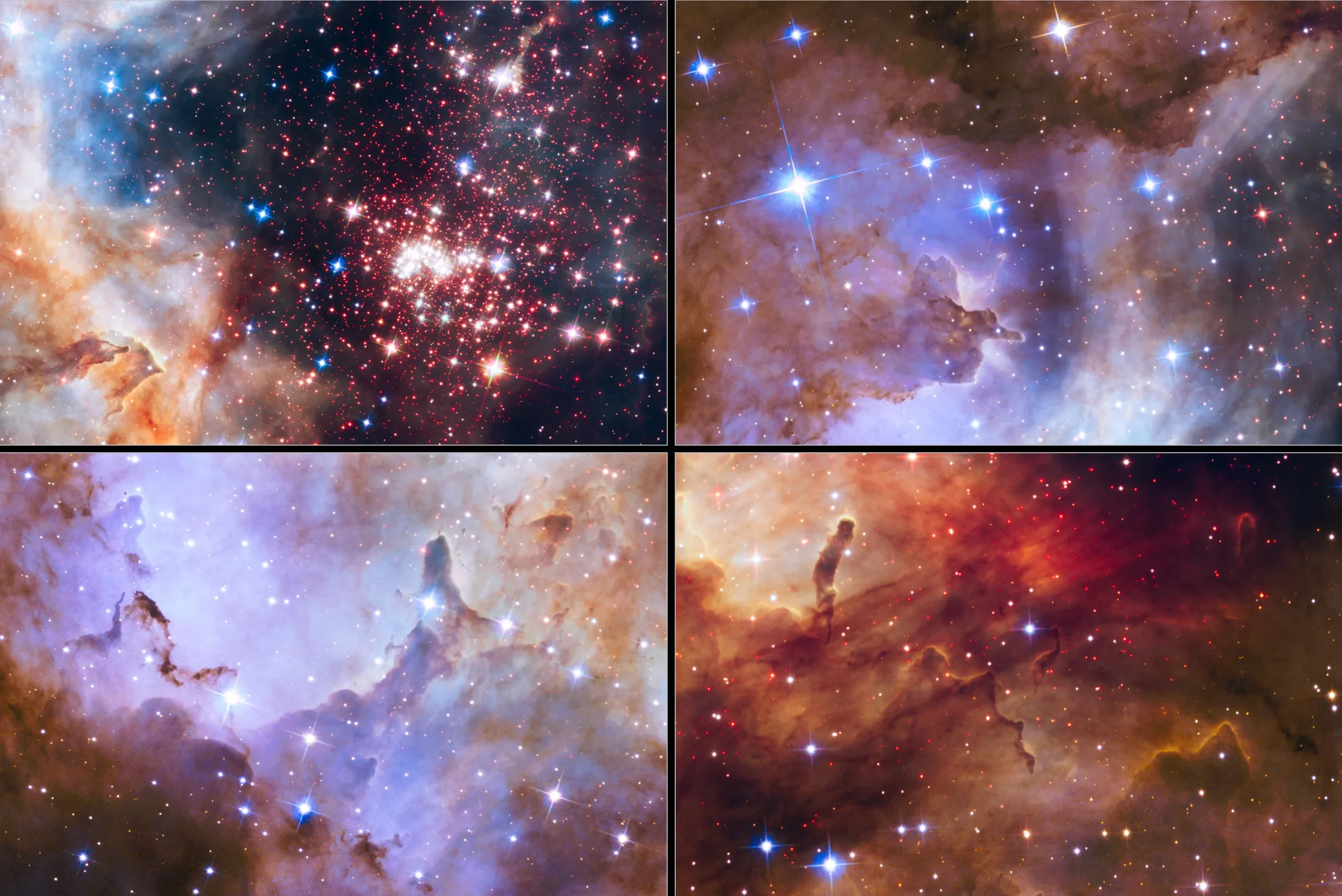
rec-dev.com – Since its launch in 1990, the Hubble Space Telescope has revolutionized our understanding of the universe. Named after the astronomer Edwin Hubble, who made significant contributions to the field of cosmology, the Hubble Telescope has become an icon of scientific exploration. Its unprecedented capabilities have allowed astronomers to peer deeper into space than ever before, capturing breathtaking images and providing invaluable data that have reshaped our view of the cosmos.

The Birth of a Cosmic Eye:
The Hubble Space Telescope was a joint project between NASA and the European Space Agency (ESA), designed to orbit the Earth and observe the universe in various wavelengths of light, including ultraviolet and infrared. Its journey began on April 24, 1990, when it was launched aboard the Space Shuttle Discovery. However, the initial excitement was soon dampened by a critical flaw in its primary mirror, which caused spherical aberration and significantly blurred the images. It wasn’t until December 1993, during the first of five servicing missions, that astronauts were able to install corrective optics, allowing Hubble to fulfill its potential.

Unveiling the Universe:
With its optical system corrected, Hubble began to deliver on its promise. It has since provided us with some of the most stunning and scientifically important images of the universe. From the deepest views of the far reaches of space, such as the Hubble Deep Field, to the detailed observations of planets within our own solar system, Hubble has been a beacon of discovery.

One of Hubble’s most significant contributions has been its role in determining the age and expansion rate of the universe. By observing distant supernovae, Hubble has helped to refine the understanding of the universe’s acceleration, leading to the acceptance of dark energy as a major component of the cosmos.

Hubble has also played a crucial role in the study of galaxies, their formation, and evolution. It has captured images of galaxies colliding, stars being born, and the intricate details of nebulae, providing insights into the life cycle of stars and the structure of the universe.

The telescope has not only focused on the vastness of space but has also turned its eye closer to home, observing the planets, moons, and asteroids within our solar system. Hubble’s images have revealed storms on Jupiter, the rings of Saturn, and the icy moons of the outer planets, contributing to our understanding of planetary science.

Legacy and Future:
The Hubble Space Telescope has been a treasure trove of scientific data, inspiring generations and leading to numerous discoveries that have pushed the boundaries of astrophysics. Its legacy is not just in the images it has captured but in the way it has fostered a sense of wonder about the universe and our place within it.

As Hubble continues to operate, its successor, the James Webb Space Telescope (JWST), is poised to carry on the exploration. Launched in December 2021, the JWST is designed to peer even further back in time and explore the earliest galaxies, the formation of stars, and the birth of planets.

Conclusion:
The Hubble Space Telescope has been an invaluable tool in the quest to understand the universe. Its contributions to astronomy and astrophysics are immeasurable, and its images have become emblematic of human curiosity and the pursuit of knowledge. As we look forward to the next generation of space telescopes, Hubble will remain a testament to what can be achieved when we reach for the stars. Its legacy will continue to inspire future explorations and discoveries, reminding us of the beauty and mystery that lies beyond our planet.

Ice Giants: Neptune and Unveiling Uranus

rec-dev.com – Ice giants, a category of planets that includes Uranus and Neptune, are fascinating celestial bodies that differ significantly from the gas giants Jupiter and Saturn. These planets are so named because their composition is believed to be dominated by “ices”—volatile substances heavier than hydrogen and helium, such as water, methane, and ammonia, which are in a solid state under the conditions found in the outer Solar System. Despite their name, ice giants are not actually made of ice as we know it on Earth; rather, these ices are under such high pressure that they exist in a supercritical fluid state, blurring the line between gaseous and liquid phases.

Discovery and Basic Characteristics

  • Uranus was discovered by William Herschel on March 13, 1781, making it the first planet discovered using a telescope. It is the seventh planet from the Sun and has a unique rotation axis that is almost parallel to the plane of the Solar System, giving it seasons unlike any other planet.
  • Neptune was discovered later, on September 23, 1846, by Johann Galle, using calculations by Urbain Le Verrier and John Couch Adams. It is the eighth and farthest known planet from the Sun in our Solar System. Neptune’s discovery was a significant moment in the history of astronomy, as it was found through mathematical predictions rather than by accidental observation.

Composition and Atmosphere

Both Uranus and Neptune have thick atmospheres dominated by hydrogen and helium, with a higher proportion of “ices” compared to the gas giants. This composition gives them a deep blue color, especially noticeable in Neptune, which is often referred to as the “blue planet.”

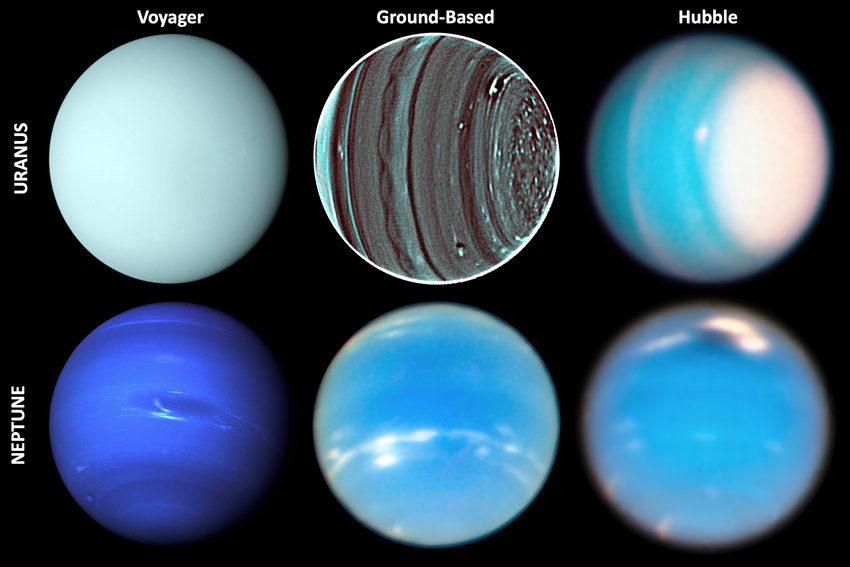
  • Uranus has a faint ring system and 27 known moons, with its atmosphere featuring strong winds and a relatively bland appearance, lacking the prominent storm systems seen on Jupiter and Saturn.
  • Neptune, despite being farther from the Sun, has a more dynamic atmosphere with powerful storms, including the Great Dark Spot, a storm similar to Jupiter’s Great Red Spot, which was observed by Voyager 2 during its 1989 flyby. Neptune also has a ring system and 14 known moons, with Triton being the largest and most intriguing due to its retrograde orbit and surface features.

Internal Structure

The internal structures of Uranus and Neptune are not as well understood as those of Jupiter and Saturn, but they are believed to have a small rocky core surrounded by a mantle of water, ammonia, and methane ices, with an outer envelope of hydrogen and helium. The high pressure in their interiors may cause the ices to behave more like hot, dense fluids than solids.

Unique Features

  • Magnetic Fields: Both planets have strong magnetic fields, but they are tilted and offset from their centers, possibly due to the dynamics within their conductive fluids.
  • Climate and Weather: Uranus and Neptune exhibit extreme weather conditions, with Neptune having the highest wind speeds of any planet in the Solar System, despite its great distance from the Sun.

Exploration

To date, only Voyager 2 has visited Uranus (in 1986) and Neptune (in 1989), providing detailed images and data that have significantly enhanced our understanding of these distant worlds. Future missions, including proposed flyby missions or orbiters, could potentially offer new insights into the ice giants’ composition, atmosphere, and formation history.

The study of Uranus and Neptune continues to be an active area of research, with astronomers using Earth-based telescopes and space-based observatories to probe their atmospheres and monitor seasonal changes. These observations are crucial for understanding not only the ice giants themselves but also the diversity of planetary systems beyond our own.