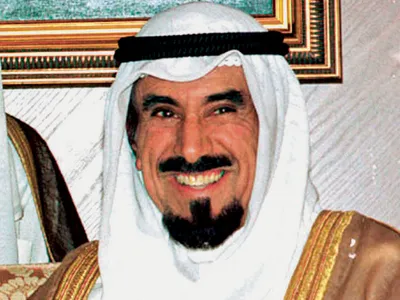
rec-dev.com – Emir Jaber Al-Ahmad Al-Sabah, who ruled Kuwait from 1977 to 2006, presided over one of the most transformative and turbulent periods in the country’s modern history. His reign was marked by rapid modernization, economic development, and significant social progress, but also by major challenges, including the Gulf War and the Iraqi invasion of Kuwait in 1990. Despite the hardships, Emir Jaber’s leadership helped guide Kuwait through recovery and reconstruction, securing its place as a leading nation in the Gulf and on the global stage.
Early Life and Political Career
Jaber Al-Ahmad Al-Sabah was born on June 29, 1926, into the prominent Al-Sabah family, which had ruled Kuwait for centuries. From a young age, Jaber was involved in government affairs, receiving his education in Kuwait and later taking on key political roles. In 1962, he was appointed Kuwait’s first Minister of Finance after the country gained independence, where he played a critical role in managing the country’s newfound oil wealth.
His time as finance minister was a period of modernization, as Kuwait began to build up its infrastructure and economy, using the proceeds from oil production. In 1965, Jaber became the Crown Prince and Prime Minister, serving alongside his predecessor, Emir Sabah Al-Salim Al-Sabah, before ascending to the throne in 1977 following Sabah’s death.
Economic Growth and Modernization
One of the most significant aspects of Emir Jaber’s reign was Kuwait’s continued economic development, driven largely by the country’s oil reserves. Under his leadership, Kuwait invested heavily in infrastructure projects, including the development of modern roads, public buildings, and educational institutions. He promoted industrial diversification to reduce dependence on oil revenues, expanding sectors such as banking, trade, and services.
During his reign, Kuwait became one of the wealthiest nations per capita, and the government used this wealth to expand the welfare state. The oil boom of the 1970s and 1980s allowed Emir Jaber to enhance Kuwait’s public services, including healthcare and education, which were made available to all citizens free of charge. This era also saw Kuwait positioning itself as a regional financial hub, attracting investments and bolstering international trade.
The Iraqi Invasion and Gulf War
Emir Jaber’s reign faced its greatest crisis with the Iraqi invasion of Kuwait on August 2, 1990. The Iraqi military, under Saddam Hussein, occupied Kuwait for seven months, leading to massive destruction and human suffering. Emir Jaber and the Kuwaiti royal family fled to Saudi Arabia, where they established a government-in-exile. Despite the traumatic event, Emir Jaber became a symbol of Kuwaiti resistance and national unity.
In exile, Emir Jaber worked tirelessly to rally international support for Kuwait’s liberation. He played a pivotal role in securing a coalition of 34 nations, led by the United States, which launched Operation Desert Storm in January 1991. The operation successfully liberated Kuwait by February 1991. Emir Jaber returned to a devastated country, but his leadership during this period was critical in securing Kuwait’s sovereignty and rebuilding national pride.
Post-Liberation Reconstruction and Reforms
After the Gulf War, Kuwait faced the enormous task of rebuilding its infrastructure and economy, which had been severely damaged during the Iraqi occupation. Emir Jaber launched an ambitious reconstruction program to restore Kuwait’s oil production, infrastructure, and public services. He oversaw the re-establishment of government institutions and prioritized the repatriation of Kuwaiti citizens who had fled during the invasion.
The post-war era was also marked by political reforms, as Emir Jaber recognized the need to strengthen the country’s democratic institutions. In 1992, he restored the National Assembly, which had been dissolved before the invasion, and Kuwait held its first parliamentary elections since the war. Emir Jaber’s commitment to constitutional governance and the promotion of free political discourse helped restore stability and trust in the government.
Despite the devastation of the war, Kuwait’s economy rebounded quickly, thanks to its substantial oil reserves and prudent financial management. Emir Jaber played a key role in ensuring that Kuwait’s economy was rebuilt on a solid foundation, enabling the country to continue its role as a major player in the global energy market.
Foreign Policy and Diplomacy
Throughout his reign, Emir Jaber was committed to maintaining Kuwait’s sovereignty and fostering strong diplomatic relations. He pursued a balanced foreign policy, emphasizing Kuwait’s role as a neutral and peaceful nation in the Middle East. Kuwait continued to be an active member of the Gulf Cooperation Council (GCC) and the Arab League, promoting regional cooperation and stability.
Emir Jaber’s efforts to rebuild relations with neighboring countries, including Iraq, were crucial in the years following the Gulf War. He also strengthened Kuwait’s ties with Western nations, particularly the United States, which remained a key ally and security partner. Under his leadership, Kuwait supported international humanitarian efforts, contributing to development projects and disaster relief across the globe through the Kuwait Fund for Arab Economic Development.
Social and Educational Reforms
Emir Jaber placed a strong emphasis on social welfare, education, and women’s rights throughout his reign. Kuwait continued to develop its public education system, and the country’s literacy rate improved dramatically. Higher education was also a priority, with the establishment of new universities and research centers.
In the realm of women’s rights, Emir Jaber supported the movement for gender equality in Kuwait. While progress was slow, Emir Jaber’s leadership laid the groundwork for future reforms. In 1999, he attempted to grant women the right to vote and run for office, though the National Assembly initially rejected the proposal. However, this set the stage for the eventual success of women’s suffrage in Kuwait in 2005.
Health Challenges and Passing
Toward the end of his reign, Emir Jaber faced health challenges that increasingly limited his public appearances. He delegated more responsibilities to his half-brother and successor, Crown Prince Sheikh Saad Al-Abdullah Al-Salim Al-Sabah, as well as to Prime Minister Sheikh Sabah Al-Ahmad Al-Sabah, who would later become emir.
On January 15, 2006, Emir Jaber Al-Ahmad Al-Sabah passed away at the age of 79, leaving behind a legacy of resilience, modernization, and leadership through crisis. His death marked the end of a nearly 30-year reign, one that saw Kuwait transform from a prosperous Gulf state into a nation that had survived occupation and emerged stronger.
Legacy
Emir Jaber Al-Ahmad Al-Sabah is remembered as one of Kuwait’s most important and transformative leaders. His ability to navigate the country through its darkest hours during the Iraqi invasion and subsequent liberation is a testament to his leadership and diplomacy. His commitment to modernization, economic growth, and social welfare helped shape modern Kuwait, creating a society that values education, healthcare, and political participation.
Despite the many challenges of his reign, Emir Jaber’s vision for Kuwait as a forward-looking, independent, and prosperous nation continues to guide the country’s development. His contributions to both Kuwait’s domestic progress and its position on the international stage have left an indelible mark on the nation’s history.
Conclusion
Emir Jaber Al-Ahmad Al-Sabah’s reign from 1977 to 2006 was a period of both tremendous progress and immense hardship. His leadership during the Iraqi invasion and the subsequent rebuilding of Kuwait stands as one of the most defining periods in the country’s modern history. Emir Jaber’s legacy of resilience, development, and diplomatic wisdom has ensured that Kuwait remains a key player in the region and a beacon of stability and prosperity in the Gulf.